
Why donors want real mail and 7 ways to make your direct mail letters great
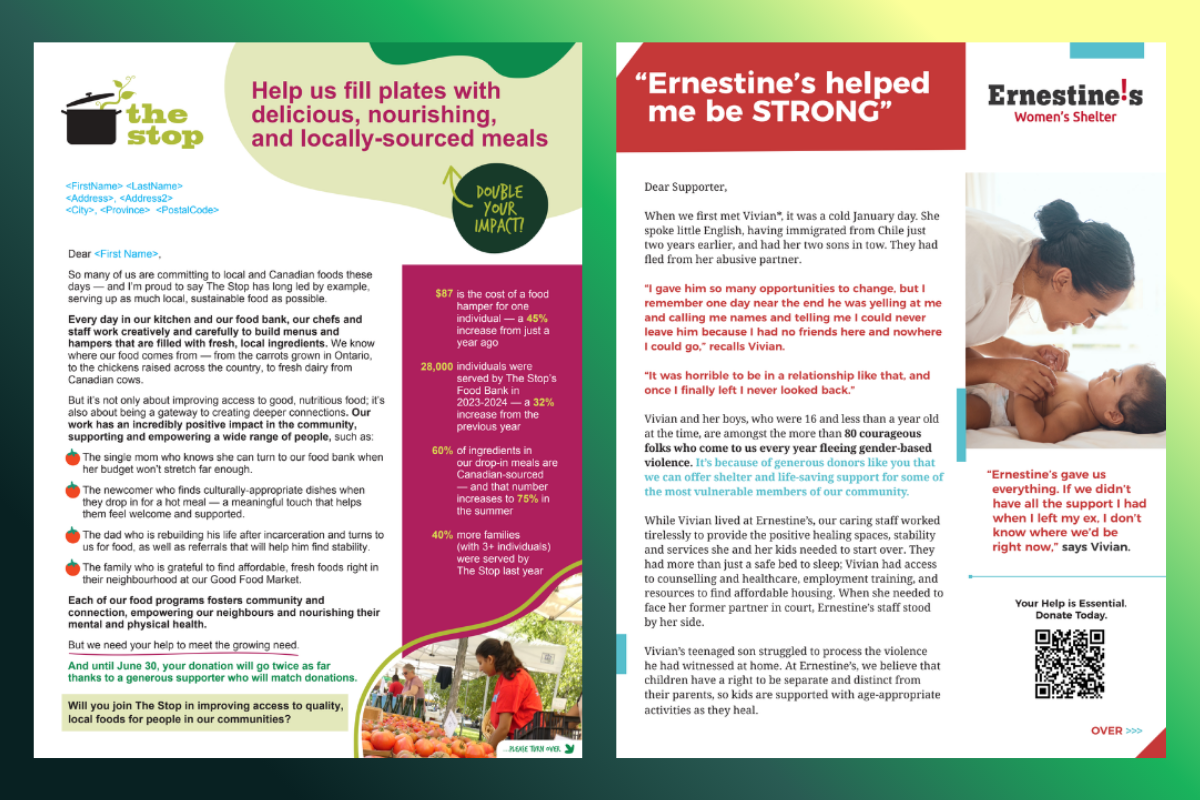
For non-profits, direct mail appeal letters are still a very effective way to fundraise. In fact, when the 2024 Canada Post strike hit during the key holiday giving season, the impact on the charitable sector was swift and severe.
Despite charities assuming that donors would simply switch channels and make their gifts online, data shows that many simply didn’t give at all. And, the 2025 Direct Mail Benchmarks for Canadian Charities by Good Works found that charities may have lost as much as a total of $1.2 billion because of the strike.
Mail is definitely not a dying channel.
And that’s because physical mail can do things that digital campaigns can’t. It sits on the counter and acts as a tangible and persistent reminder of your presence, and it even engages the senses, such as touch and smell to create an emotional connection.
But at the heart of your appeal is what you write in the letter. Here are a few tips to make it great.
Start with a strong opening and make an emotional connection. A provocative question or story grabs attention. Storytelling is the most powerful way in which we communicate with each other and donors make decisions on an emotional level. To get the response you want, you need to reach them by pulling on heartstrings and compelling them to act.
Make it as long or as short as you need. This might be surprising, but short letters aren’t always the way to go. You don’t need to be brief but you need to be compelling; make the letter as long as you need to effectively make your case for support.
Write how you speak. An appeal letter may be mass communication, but it’s still one-to-one communication; it’s a letter written by one person to another. Avoid jargon and corporate speak and use the word ‘you’ instead of ‘donors’ or ‘supporters’. In fact, use twice as many ‘yous’ as you do ‘I’, ‘We’, and ‘Our’. And since this is a friendly letter not an essay or corporate engagement proposal, it’s okay to break some grammar rules.
Write for people who scan. Since we’re breaking grammar rules anyway:
vary sentence and paragraph length
bold, underline, and italicize key points
use subheadings to break up the content
And when you get to design, consider indenting paragraphs for easy reading and be mindful of font size as the average audience age is likely over 50.
Vary your signatories. Your letter always needs to be signed by a real person but it doesn’t have to be the same person for every campaign. Changing it up provides different perspectives and offers more options to connect with donors. (Pro tip: Signatures in blue ink rather than black raise more money because they give a sense that someone took the time to personally sign the letter.)
Include a clear problem and solution. The whole point of the letter is to ask the audience to do something so make the ask obvious. Be clear, be bold and ask for exactly what you want. And, be sure to state the impact this support will have and maybe even what will happen if donors don’t help you solve it.
Lean into the donor’s reading path. This might be a letter, but most donors won’t read it like a traditional letter. They’ll first check to see if their name is at the top, then they’ll look to the bottom to see who sent it. After checking those two boxes, they will read anything that breaks up the text — that means the full context of the letter needs to be fully understood by someone who only reads the headlines, subheadings, and underlined/bold sentences.